

Lions Prostate Cancer Research & Treatment Project
“Prostate check, not that scary after all”

PSA Check blood test & other diagnosis options
There is a blood test to check for prostate-specific antigen (PSA), a protein produced by the prostate; the level of PSA can be higher than normal in people with prostate cancer (but also in people with other prostate conditions that are not cancer) A number of other tests may be performed to investigate symptoms of prostate cancer and confirm a diagnosis.
- medical history, family history and physical examination
- digital rectal examination
- genetic tests that look for inherited gene changes
- transrectal ultrasound
- imaging tests such as a CT scan and a bone scan
- mpMRI, a specialised type of medical scan
- PET scan or a bone scan.
- PSMA-PET scan may be done to specifically look for prostate cancer activity.
- biopsy (usually after having an MRI scan)

Information sourced from www.canceraustralia.gov.au

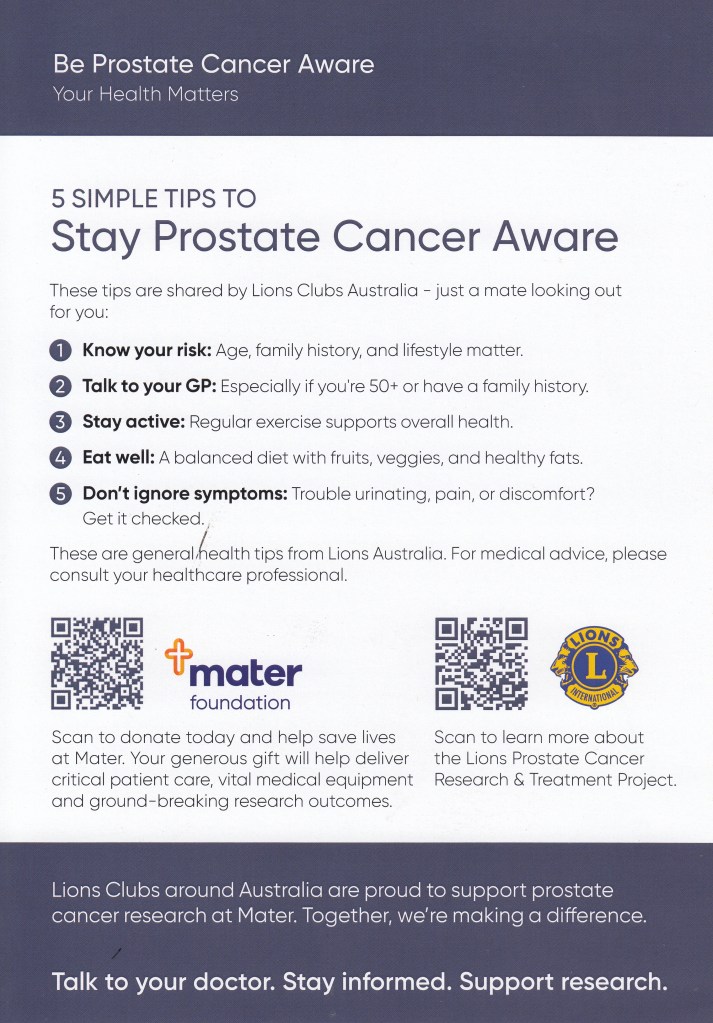

Click on “Should I have a PSA test?“to download printable .pdf document.
Changes in Medicare Prostate Specific Antigen(PSA) Testing Criteria, (from 1 Nov 2023) as advised by Melbourne Pathology.
PSA testing (Prostate Specific Antigen) – This test is requested by your GP in order to screen for prostate disease or to monitor previously diagnosed prostate disease.
Prostate Cancer Testing information from Melbourne Pathology


ABOUT THIS TEST – We test for the prostate specific antigen (PSA) to diagnose and monitor prostate cancer. We’ll need a blood sample from your arm. If you’re on a high dose of Biotin, you need to wait three days after your last dose before having the test.

Better Health Channel and Victorian Government, Dept of Health – general information on Prostate cancer testing. Please click on link to Better Health Channel.

SA Health information on Prostate Specific Antigen (PSA) information and link to SA Pathology Services. SA Pathology provides a complete diagnostic and clinical service for our patients and the South Australian population. click on the SA Health logo for link to SA Health website.



Lions Prostate Cancer Research & Treatment Project
P O Box 42, Holland Park Qld 4121
Project Chairman – Lion Patrick O’Donoghue
email: prostatedist201@gmail.com
Host Lions Club: Lions Club of Brisbane Holland Park Inc
 Lions Prostate Cancer Research & Treatment Project